Dutch
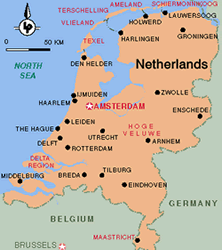
Dutch belongs to the west Germanic branch of the Indo-European language family spoken by 16.4 million people in the Netherlands (Holland) and in the northern half of Belgium (Flanders, including Belgium’s capital Brussels). It is also spoken Also in Aruba, Belgium (Flemish), Brazil, Canada, Caribbean Netherlands, Curacao, Germany, Sint Maarten, South Africa, Suriname, United States. The worldwide population of Dutch speakers is 23 million people (Ethnologue).
The word ‘Dutch’ comes from the old Germanic word theodisk that referred to the language spoken by the people as opposed to the official Latin. Theodisk became deutsch in modern German. In Dutch, theodisk became two different words: duits, meaning ‘German’, and diets, meaning ‘ Dutch’, a term no longer used. Today, theodisk survives as tedesco, the Italian word for ‘German’.
 Prior to Holland’s becoming an independent country in 1550, the English word Dutch was used to refer to any Germanic language. To this day, descendants of German settlers in southeastern Pennsylvania are known as the Pennsylvania Dutch.
Status
- Netherlands
Dutch is the national statutory language of the Netherlands where it is spoken by 16.4 million people. - Belgium
Dutch is an national statutory language of Belgium, along with French and German. It spoken by over 6 million people. - France
Although there are 80,000 speakers of Dutch (called Vlaams, or Flemish) in the northeast corner of France, it has no official recognition. - Aruba
Dutch is de facto national working language of Aruba where it is spoken by 5,290 people, but its use is declining. - Bonaire, St. Eustatius and Saba
Dutch is the national statutory language of Bonaire, St. Eustatius and Saba with about 21,000 speakers. - Curaçao
Dutch is de facto national working language with over 11,400 speakers. - Sint Maarten (Dutch part)
Dutch is the national statutory language with 2,000 speakers. - Suriname
Dutch is de facto national language of Suriname with 200,000 speakers.
Dialects
The dialect picture is somewhat complicated since Dutch is spoken in several countries.The variety of Dutch spoken in Belgium is known as Flemish. There is a dialect continuum between Dutch and Low German so that there is no clear boundary between the two languages. Some German dialects are closer to Dutch than they are to Standard German.
- Netherlands
Low German spoken in Groningen, Drenthe and Overijssel
Zuid-Gelders which is also spoken in the North Rhine-Westphalia area of Germany
Brabantian
Linburgish - Belgium
Flemish dialects are characterized by a large number of French loanwords, e.g., the Flemish word for ‘fork’ is fourchette, instead of the Dutch vork. Several dialects are identified.
West Flemish which is also spoken in part of the Dutch province of Zeeland, and in a small area near Dunkirk (France) on the Belgian border
East Flemish
Brabantian
Linburgish
Structure
Sound system
Vowels
A distinguishing characteristic of the Dutch sound system is its large inventory of vowels and diphthongs. It has 16 vowel phonemes: 5 of them are short, and 7 are long. In addition, Dutch has 3 diphthongs: / ɛi, øy, ɔu/. In the table below, length is identified by a colon after the vowel.
|
Unrounded
|
Rounded
|
Unrounded
|
Rounded
|
|
| Close |
i:
|
y:
|
u:
|
|
| Close-Mid |
I
|
ʏ
|
o:
|
|
| Mid |
e:
|
ø:
|
ə
|
|
| Open-mid |
ɛ
|
ɔ
|
||
| Open |
a:
|
ɑ
|
||
- /i/ = ee in beet
- /I/ = I in bit
- /e/ = ai in bait
- /ɛ/ = e in bet
- /y, ʏ, ø/ have no equivalents in English
- /ə/ = u in but
- /a/ = a in bat
- /u/ = oo in boot
- /o/ = oa in boat
- /ɔ/ = ough in bought
- /ɑ/ = o in pop
Consonants
Below are the consonant phonemes of Dutch. They are subject to dialect differences.
| Stops |
p
|
t
|
k
|
||||||
|
b
|
d
|
(g)
|
|||||||
| Fricatives |
f
|
s
|
ʃ
|
x
|
(ʁ)
|
||||
| voiced |
v
|
z
|
(ʒ)
|
ɣ
|
ɦ
|
||||
| Nasals |
m
|
n
|
ŋ
|
||||||
| Lateral |
l
|
||||||||
| Trill |
(r)
|
(ʀ)
|
|||||||
| Semivowels |
ʋ
|
j
|
- /ʃ/ = sh in shop
- /ʒ/ = s in vision
- /x, ɣ/ have no equivalents in English
- /ŋ/ = ng in song
- /r/ can be realized as a trilled alveolar /r/, a uvular fricative /ʁ/ or a uvular trill /ʀ/, depending on the dialect
- /g, ʃ, ʒ/ occur primarily in borrowed words.
- /v, z, ɣ / are in the process of disappearing in some dialects
- /ʀ/ appears only in some dialects; it is similar to French
- /ʋ/ = closest equivalent is the first consonant in phew
- voiced paired consonants become voiceless at the end of words, e.g., e.g., baard ‘beard’ is pronounced as /baart/.
Stress
Stress in Dutch words usually falls on the first syllable but there are some exceptions.
Grammar
Dutch grammar is simpler than that of German because it lost noun and adjective declensions, although it still retains some pronominal inflections, like English.
Nouns, pronouns, and adjectives
- Dutch has two two genders – common and neuter.
- There are two numbers: singular and plural, e.g., de lamp – de lampen, de computer – de computers.
- There are two definite articles: de for common gender, e.g., de man ‘the man’, and het for neuter gender, e.g., het huis ‘the house’.
- There is one indefinite article een, e.g., een man ‘a man,’ een huis ‘a house’.
- Adjectives that modify common nouns take the ending –e, e.g., een goede man ‘a good man’.
Verbs
- There are two simple tenses: present and past, e.g., ik werk ‘I work’ and ik werkte ‘I worked’. In the past tense, weak verbs add –te for singular and –ten for plural, e.g., ik werkte ‘I worked’, wij werkten ‘we worked’. Strong verbs use umlaut (similar to Engliish), e.g., slap ‘sleep’, sliep ‘slept’.
- Future is formed using the auxiliary verb zullen, e.g., ik zal slapen ‘I will sleep’.
- There are two aspects: perfective and imperfective. The perfective is formed with the auxiliary verb hebben, e.g., ik heb geslapen ‘I have slept’, ik had geslapen ‘I had slept’.
- There are three moods: indicative, imperative, and conditional.
- There are three voices: active, middle, and passive
Click here for a Dutch verb conjugator.
Word order
Word order in Dutch is Subject-Verb-Object for main clauses, Subject-Object-Verb for subordinate clauses, and Verb-Subject-Object for interrogative sentences. Modifiers precede nouns, e.g., een goed huis ‘a good house’.
Vocabulary
The vocabulary of Dutch is Germanic in origin, hence it is quite similar to that of other Germanic languages. Like German, Dutch is known for making building long words from native components. The number of borrowings from English is quite large and growing.
Below are some common Dutch words and phrases.
| Hello | Hallo |
| Good bye | Tot ziens |
| Please | Alstublieft |
| Thank you | Dank u wel. |
| Excuse me | Het spijt me |
| Yes | Ja |
| No | Nee |
| Man | Man |
| Woman | Vrouw. |
The Dutch numerals 1-10 are listed below.
|
1
|
2
|
3
|
4
|
5
|
6
|
7
|
8
|
9
|
10
|
|---|---|---|---|---|---|---|---|---|---|
|
een
|
twee
|
drie
|
vier
|
vijf
|
zes
|
zeven
|
acht
|
negen
|
tien
|
Writing
Dutch is written with the Latin alphabet consisting of 26 letters. The Dutch alphabet was standardized in 1863, and revised and simplified in 1947, with many attempts at reform before and after. It is given below.
|
A a
|
B b
|
C c
|
D d
|
E e
|
Ff
|
G g
|
H
|
I i
|
J j
|
K k
|
L l
|
M m
|
|
N n
|
O o
|
P p
|
Q q
|
R r
|
S s
|
T t
|
U u
|
V v
|
W w
|
X x
|
Y y or (IJ ij)
|
Zz
|
-
Qq, Xx, Yy are used mostly in loanwords.
- Double vowels represent long vowels.
- The diaeresis is used to mark vowels that are pronounced separately.
- The acute accent occurs mainly in loanwords like café, but can also be used to differentiate words that are identical except for stress.
- g represents a velar fricative similar to ch in Loch.
- j = y in yet
- v = f in folk
- w = v in vale
- sch = sh in shop
Take a look at Article 1 of the Universal Declaration of Human Rights in Dutch.
| UNIVERSELE VERKLARING VAN DE RECHTEN VAN DE MENS Artikel 1 Alle mensen worden vrij en gelijk in waardigheid en rechten geboren. Zij zijn begiftigd met verstand en geweten, en behoren zich jegens elkaar in een geest van broederschap te gedragen. |
| Universal Declaration of Human Rights Article 1 All human beings are born free and equal in dignity and rights. They are endowed with reason and conscience and should act towards one another in a spirit of brotherhood. |
Did You Know?
English has many words of Dutch origin, too many to list here. Among them are:
- Place names in New York City, such as Brooklyn (after the Dutch city Breukelen), Harlem (from the name of a Dutch settlement in Manhattan Nieuw Haarlem, after the Dutch city Haarlem), and Bowery (from bowerij ‘farm’); specifically the farm of Peter Stuyvesant, who bought most of the surrounding land in 1651. These names are reminders of the time when Manhattan was the Dutch colony of New Amsterdam.
- Nautical terms, e.g., ahoy, buoy, dock, cruise, freight, skipper, sloop.
- Names of winter sports, e.g., skate, sled, sleigh.
- Names of foods, e.g., Edam, Gouda, and Limburger cheese; waffle, cruller, scone pastry.
|
English word
|
from Dutch
|
|---|---|
| brandy | brandewijn ‘burnt wine’, so called because it is distilled |
| frolic | vrolyc ‘happy’, from vro– ‘merry, glad’ + lyc ‘like’ |
| gas | gas |
| gin | genever ‘juniper’ (because the alcohol was flavored with its berries) |
| landscape | landschap ‘landscape’ |
| measles | masel ‘blemish’ |
| pump | pompe ‘water conduit, pipe’ |
| roster | rooster ‘table, list’ |
| smuggle | smokkelen ‘to transport (goods) illegally’ |
| stoop | stoep ‘flight of steps, doorstep, stoop’ |
| wagon | wagen ‘wagon’ |
| poppycock | probably from pappekak ‘soft dung’ |
| Santa Claus | Sante Klaas |
| yankee | a disparaging name applied by Dutch settlers in New Amsterdam (New York) to English colonists in neighboring Connecticut. It may be from Dutch Janke ‘Little John’, diminutive of Jan ‘John’. |
Difficulty
 How difficult is it to learn Dutch?
Dutch is considered to be a Category I language in terms of difficulty for speakers of English.